When the Spreadsheet Isn't Enough: Building a Smarter Project Digest
There's a particular kind of operational problem that doesn't announce itself loudly. Nobody misses a major deadline. Nothing catastrophic happens. But things slip — quietly, consistently — because the system for tracking them requires someone to go looking.
That was the situation I walked into with a founder I work with who manages multiple client projects simultaneously across several Trello boards. The boards were organized. The due dates were set. But Trello notifications are easy to miss, and nobody was opening the app first thing Monday morning to triage the week.
The result? Overdue tasks that sat unnoticed for days. Due dates that crept up without warning. A founder spending mental energy trying to remember what was coming instead of focusing on the work itself.
The fix wasn't more reminders. It was better information, delivered at the right time.
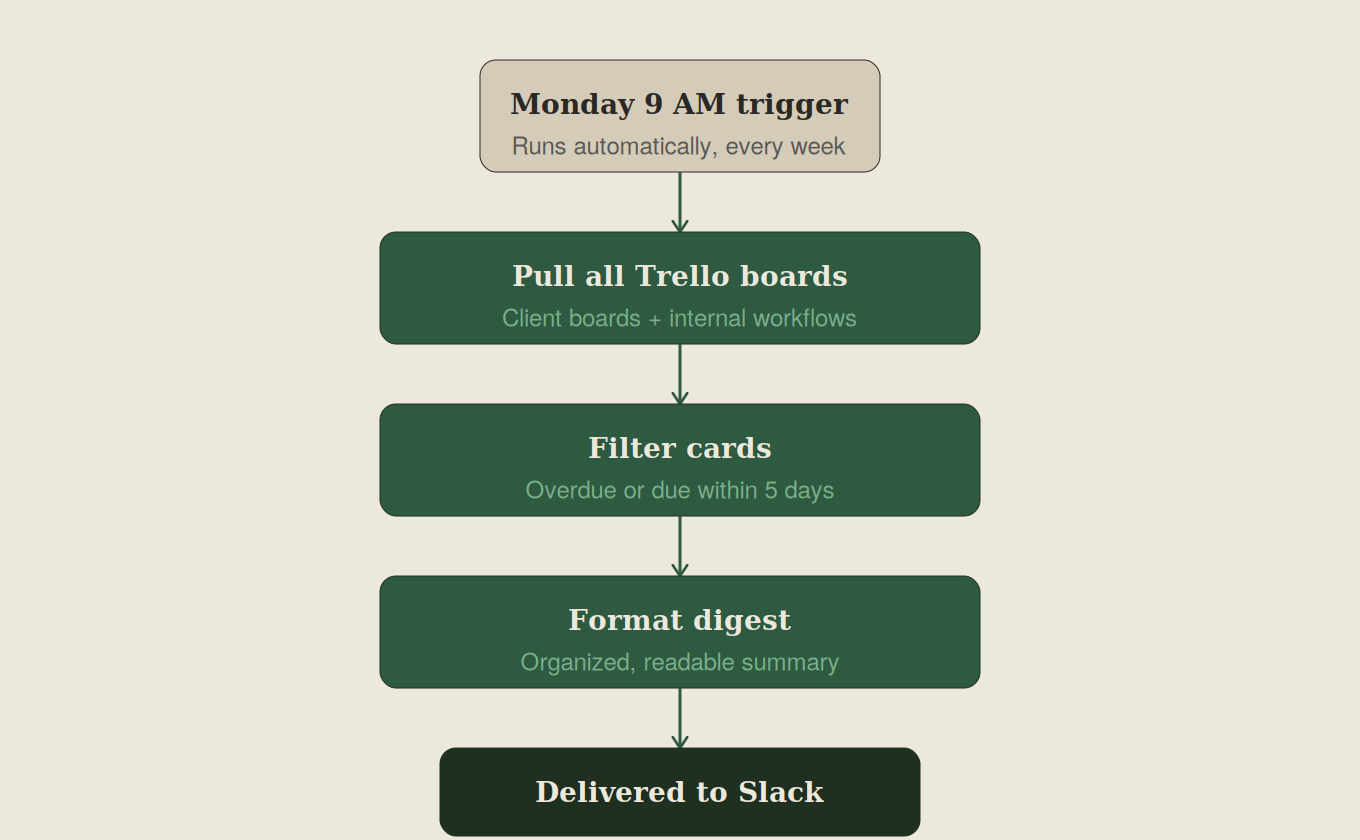
Here's what I built: an automated digest that pulls from all of her Trello boards every Monday morning at 9 AM, surfaces every card that's either overdue or due within the next five days, formats it cleanly, and delivers it as a Slack message — waiting for her when she opens her laptop to start the week.
No logging into Trello. No hunting across boards. Just a clear, prioritized view of what needs attention, right where she already lives.
The impact was immediate. Overdue tasks stopped quietly accumulating. Monday mornings got a clear starting point. And the weekly prioritization conversation — what used to happen reactively — started happening proactively.
The broader lesson
The tool wasn't the problem. Trello is a perfectly good project management tool. The gap was in how information from that tool was being surfaced — or wasn't being surfaced — at the moment it was actually useful.
This is true for a lot of operational friction I see in early-stage businesses. The data exists. The processes exist. The missing piece is a layer of automation that connects them in a way that fits how you actually work.
That's the kind of problem I love solving.
Wiley Collective builds operational infrastructure for founders who are ready to stop running their business on instinct and start running it on systems. Let's talk.
