How I Automated My Weekly Client Update (And Got One Hour Back Every Friday)
I have a rule I hold myself to: every client should always know where my time is going and why. Not because they're asking, but because that transparency is part of what makes the relationship work.
The problem was executing on that consistently without it eating my Friday afternoon.
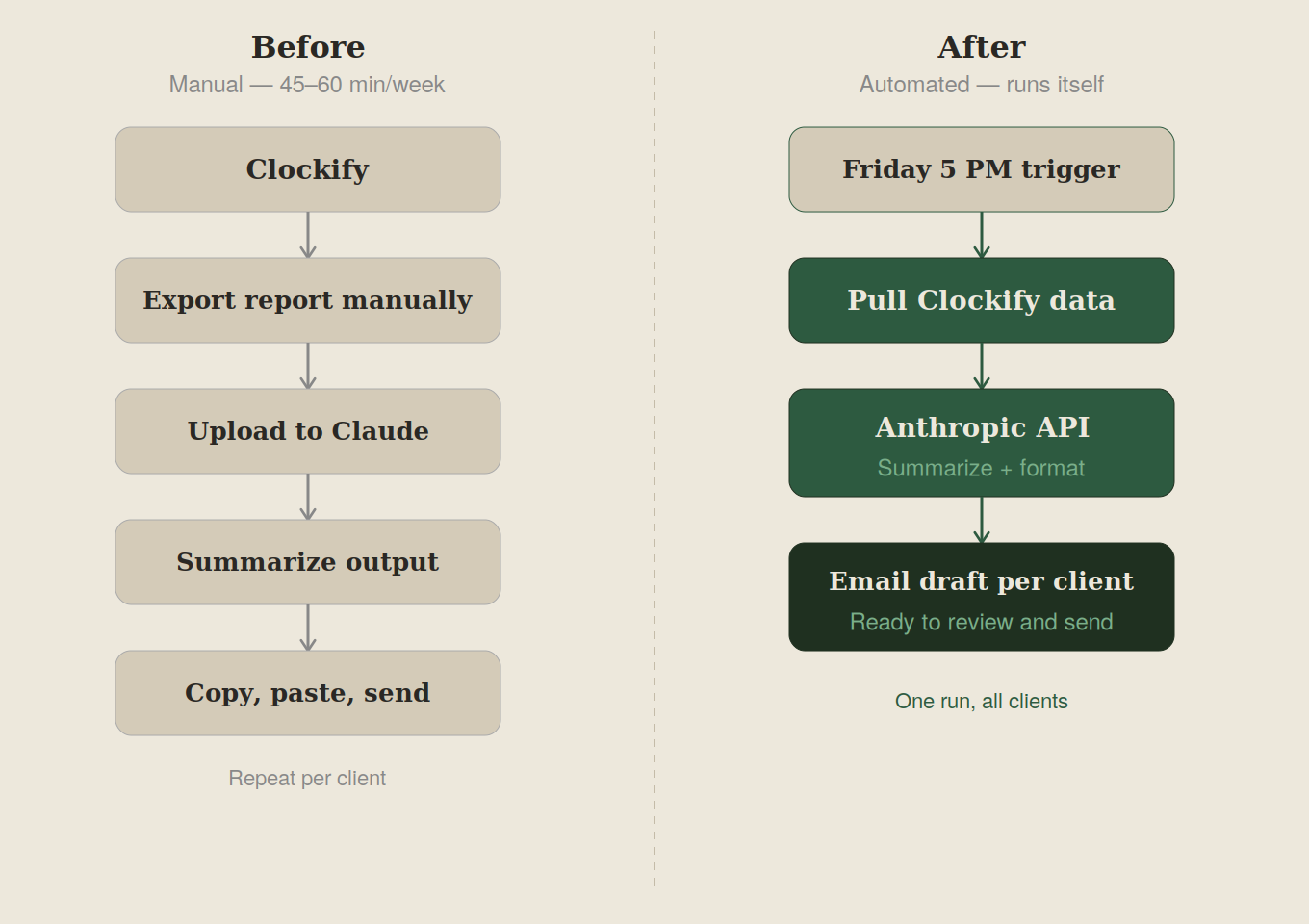
My old process looked like this: open Clockify, export the week's time report, upload it to Claude, ask for a summary, copy the output, paste it into an email, personalize it, send. Repeat for each client. The whole thing took 45 minutes to an hour every single Friday.
It worked. But it was friction I had created for myself — and friction I knew I could eliminate.
What I built
I built an automated integration that runs every Friday at 5 PM. Here's what it does:
It pulls my time tracking data from Clockify for the week, broken down by client and task. It feeds that data to the Anthropic API, which generates a clear, readable summary — total hours, individual tasks, and a narrative explanation of where the time went and what was accomplished. Then it drafts a personalized email for each client and sends it directly to my drafts folder, ready to review and send.
One integration. Multiple clients. Zero manual work.
Why this matters beyond the time savings
The 45 minutes back every Friday is great. But the bigger win is consistency. Before, the update happened when I got to it. Now it happens every single week without me having to remember, prioritize, or carve out time for it.
My clients get a reliable touchpoint. I get to close out the week cleanly. And the cognitive load of "I still need to send that update" just doesn't exist anymore.
The broader principle
The manual version of this process wasn't broken — it just didn't need to be manual. The data existed in Clockify. The structure of a good client update was something I'd already figured out. The Anthropic API was the bridge that connected the two.
This is the kind of integration work I find genuinely interesting: identifying where good data already exists in your workflow and building the layer that puts it to work automatically.
The result isn't just time saved. It's one less thing to think about — which, for a founder running a lean operation, is often worth more than the hours themselves.
Wiley Collective builds operational infrastructure for founders who are ready to stop running their business on instinct and start running it on systems. Let's talk.
